Announcing the BC Young Optometrist of the Year: Dr. Sophia Capo. Read More

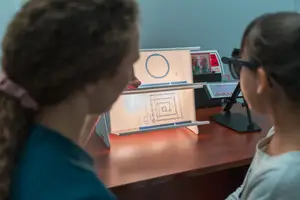
We Assess Visual Skills at Our Lower Mission Eye Care Center
If you or your child is experiencing challenges with reading, focus, or visual comfort, a visual skills assessment helps identify the root cause and guide the right next steps.
This is different from a routine eye exam and is designed to evaluate how your visual system functions during real-world tasks.
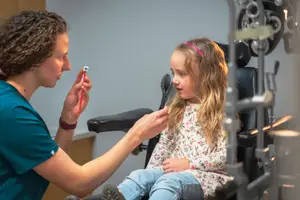
When Should You Consider a Visual Skills Assessment?
When Your Eyes Miss the Memo
You may benefit from a visual skills assessment if you or your child:
- Struggle with reading or comprehension
- Lose place or skip lines while reading
- Experience headaches or discomfort during near work
- Have difficulty maintaining attention on visual tasks
- Notice double vision or inconsistent clarity
- Are recovering from a concussion or brain injury
If something does not feel right, even when vision appears clear, this assessment can help identify underlying issues.
How Your Eyes Work Together
Your eyes are designed to work as a coordinated system. When that coordination is not functioning properly, your brain must work harder to maintain stable vision.
This added effort can affect how efficiently you process visual information and complete everyday tasks.
A visual skills assessment helps identify where this coordination is not working as expected.
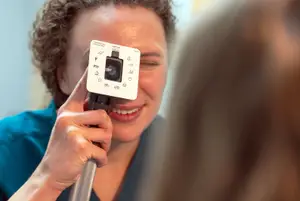
What Is Being Evaluated During the Assessment?
During a visual skills assessment, we look at how your eyes function individually and together during everyday tasks.
This includes evaluating how your eyes focus, move, and coordinate, as well as how consistently they respond over time.
These measurements help us understand how your visual system is performing and identify where it may not be working as efficiently as it should.
When you look from a near object to a far object, your eyes automatically engage muscles to focus and maintain a clear image. Accommodative dysfunction is when the eyes adjust poorly, affecting comfort and visual quality.
Signs and symptoms of poor eye focusing can include:
- Blurry vision when shifting focus
- Poor posture to compensate for eye fatigue
- Tired or strained eyes
- Poor concentration or task avoidance
Depth perception is the ability to see objects in 3D. It's a skill we use to judge accurately how far or near something is. Both eyes have a slightly different view, allowing the brain to compare and gather more dynamic information.
When the brain can't process the information from one or both eyes, depth perception is impaired. Kids can struggle with simple tasks, like pouring a glass of milk, climbing stairs, or catching a ball.
From tracking soccer players across a field to glancing up when someone calls your name, eye movement is crucial for a range of visual functions. Kids with poor eye muscle control can face challenges with multiple aspects of binocular vision.
The inability to control eye movements can also indicate a central nervous system condition, from inflammation to neurological disorders.
Evaluating the eye's resting position can help determine if a child has eye misalignment. Eye position can affect how the eyes work together, as they need to focus on the same object simultaneously.
Common eye misalignment problems, like strabismus (crossed eyes) and amblyopia (lazy eye), can cause:
- Strained or tired eyes
- Double vision
- Headaches
- Poor depth perception
Convergence is when our eyes move together and aim inward when looking at close distances. Your child may struggle to focus on a sentence or word because their eyes don't line up, resulting in a mismatched image. Kids with convergence insufficiency (poor eye teaming) can experience:
- Blurred or double vision
- Poor concentration
- Headaches
- Vertigo or motion sickness
- Tiredness after near-vision activities
- Poor reading comprehension
Book a Visual Skills Assessment in Kelowna
If you or your child is experiencing challenges with reading, focus, or visual comfort, a comprehensive visual skills assessment can help identify the underlying cause and guide the right next steps.
Our optometrists will take the time to understand how your eyes are working together and provide clear recommendations based on your needs.