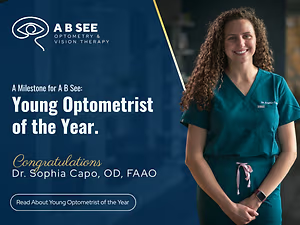
Announcing the BC Young Optometrist of the Year: Dr. Sophia Capo. Read More
Concussion Vision Rehabilitation in Kelowna, BC
Vision is more than eyesight – it’s a partnership between the eyes and brain. When that connection is disrupted by concussion or developmental challenges, everyday tasks can become difficult.
Dr. Capo’s advanced neuro-optometric training, combined with collaboration across medical specialists, provides patients with a coordinated path to recovery.
What is Concussion Vision Syndrome?
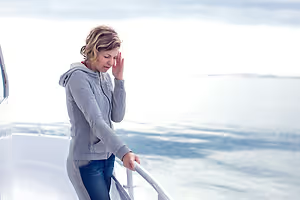
Concussion vision syndrome occurs when a head injury affects how the eyes and brain work together.
Even mild concussions can disrupt visual coordination, making everyday tasks feel more difficult than they should. Your eyes may have trouble staying aligned, maintaining focus, or moving smoothly—especially during activities like reading, screen use, or being in busy environments.
Common Visual Changes After a Concussion
Concussion vision syndrome occurs when a head injury affects how the eyes and brain work together.
Even mild concussions can disrupt visual coordination, making everyday tasks feel more difficult than they should. Your eyes may have trouble staying aligned, maintaining focus, or moving smoothly—especially during activities like reading, screen use, or being in busy environments.
After a concussion, the eyes may struggle to work together at near. This is called convergence insufficiency. This can make reading uncomfortable and harder to sustain over time.
Accommodative dysfunction affects how the eyes focus. It can make it difficult to keep things clear up close or shift focus between distances comfortably and efficiently.
Testimonials From Google
I’ve been struggling with Post-Concussion Syndrome for a few years now, and was recently referred to Dr. Capo for ongoing balance issues. After a detailed & thorough examination, Dr. Capo determined that although I have 20/20 vision, I’m suffering with “convergence issues”. She then prescribed me with prism glasses and vision therapy, which have proved to be one of the most profound & helpful therapies I’ve had in my concussion journey thus far.
~ Patient, Age 60

How do I know if my symptoms are related to a concussion?
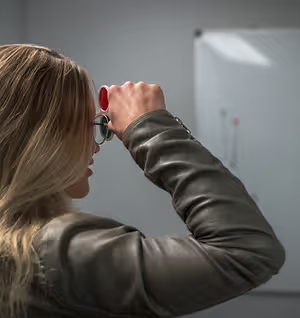
Visual problems after a concussion are common—but often missed.You may notice that visual tasks feel more effortful, less comfortable, or harder to maintain than before your injury. These changes are not always detected in a standard eye exam.
A visual skills assessment can determine how your visual system has been affected and whether treatment would be helpful.
Take the next step in your recovery.
Common Symptoms Of Brain-Related Vision Problems
Vision problems caused by neurological conditions can affect more than how clearly you can see.
Changes to your visual abilities can interfere with common visual tasks like reading, driving, and computer use.
Patients can also experience:
- Blurred or double vision
- Poor depth perception
- Poor peripheral (side) vision
- Balance difficulties
- Headaches or eye strain
- Frequent blinking or squinting
- Slower processing speed
- Difficulties making timely decisions
Let’s Start with a Visual Skills Assessment
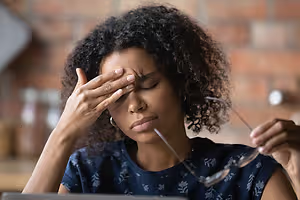
The first step is a visual skills assessment, where we look beyond 20/20 to understand how your eyes are working together. From there, we’ll guide you through the next steps and determine whether vision therapy is right for you.