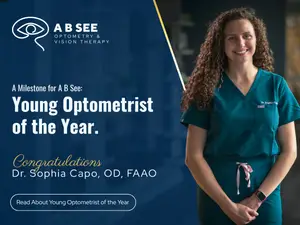
Announcing the BC Young Optometrist of the Year: Dr. Sophia Capo. Read More

Low Vision Rehabilitation: What It Is and How It Helps

If your eyesight isn’t what it used to be, and glasses aren’t doing the trick, you’re not out of options. At A B See Optometry and Vision Therapy, we offer customized low vision rehabilitation to help you stay independent and enjoy your daily life.
We use vision therapy and comprehensive eye exams to evaluate and support vision loss.
Significant changes in vision can feel disorienting. But low vision doesn’t mean giving up your lifestyle. Through rehabilitation, our team helps patients make the most of their remaining sight and maintain their freedom through tailored care, visual tools, and education.
If you’re new to this specialty service, here are the most frequently asked questions we hear at our Kelowna clinic.
What Is Low Vision Rehabilitation?
Low vision describes a visual impairment that glasses, contact lenses, or standard treatments cannot fully correct. It can result from age-related eye conditions like macular degeneration, glaucoma, or diabetic retinopathy. Injury or neurological conditions may also be a factor.
Low vision rehabilitation focuses on maximizing usable sight. Support may include:
- Training with adaptive devices
- Enhancing contrast and lighting
- Teaching visual strategies for daily tasks
- Recommending specific low vision aids (like magnifiers or specialized eyewear)
Unlike a single procedure, low vision rehabilitation is a personalized process designed to evolve with your changing needs. Our priority is to help you use your vision effectively and continue doing what matters most.
Who Is a Candidate for Low Vision Rehabilitation?
If your vision loss affects your independence, it may be time to consider low vision care. Candidates include:
- Patients with central or peripheral vision loss
- People who have trouble reading, cooking, driving, or using devices
- Individuals who find daily life more difficult despite using prescription eyewear
If standard prescription glasses are no longer enough, low vision rehabilitation may help. There’s no need to wait until vision loss becomes severe. Early support often leads to better outcomes.
What Tools or Devices Are Used in Low Vision Care?
We choose the solutions we recommend based on your vision needs and lifestyle. Common options include:
- Magnifiers: Handheld, stand-mounted, or digital
- Specialty lenses: Telescopic or prismatic lenses
- Electronic tools: Screen readers or video magnifiers
- Non-optical tools: Large-print books, high-contrast clocks, and mobility devices
But using tools correctly is just the beginning. We guide you through training so these aids feel intuitive and empowering—not frustrating.
What Happens During a Low Vision Appointment?
Your first low vision assessment at A B See Optometry and Vision Therapy will be different from a typical eye exam. We take a functional approach, focusing on how your vision affects your daily routines and what goals you would like to achieve.
During your visit, we may:
- Assess your current visual acuity and functional vision
- Ask detailed questions about your daily activities and challenges
- Demonstrate different vision aids to determine what works best
- Provide training or strategies to use your vision more effectively
We don't rush this process. Whether your goal is reading the newspaper, seeing your grandchildren’s faces, or moving safely through your home, we’ll help you find solutions that work.
How Long Does Low Vision Rehabilitation Take?
Some patients see improvement in just a few sessions. Others benefit from longer-term support and training. The process is flexible and shaped by your needs.
As your needs evolve or new technologies become available, we’ll reassess and refine your strategy. We may also collaborate with occupational therapists or mobility trainers to ensure well-rounded support.
Is Low Vision Care Covered by Insurance?
Coverage varies by plan. Many assistive devices are partially or fully reimbursed by private or extended health benefits. We’ll walk you through your options and provide documentation to support any claims.
We also prioritize cost-effective care and discuss pricing upfront, so you can focus on support—not stress.
Kelowna’s Local Resource for Low Vision Rehabilitation
At A B See Optometry and Vision Therapy, we provide compassionate, expert low vision care right here in Kelowna.
If you’re struggling with reading, facial recognition, or safely moving through your space, we can help. Our clinic offers customized low vision strategies and advanced vision care tools tailored to your lifestyle.
Take the First Step Toward Better Vision Support
You don’t need to face vision loss alone. Our team at A B See Optometry and Vision Therapy is here to help you regain clarity, connection, and control.
Book a low vision assessment in Kelowna and discover how personalized care can help you navigate daily life with more ease and confidence.